Futures Rise, Nasdaq Up 10 Days In A Row, On Iran De-escalation Optimism
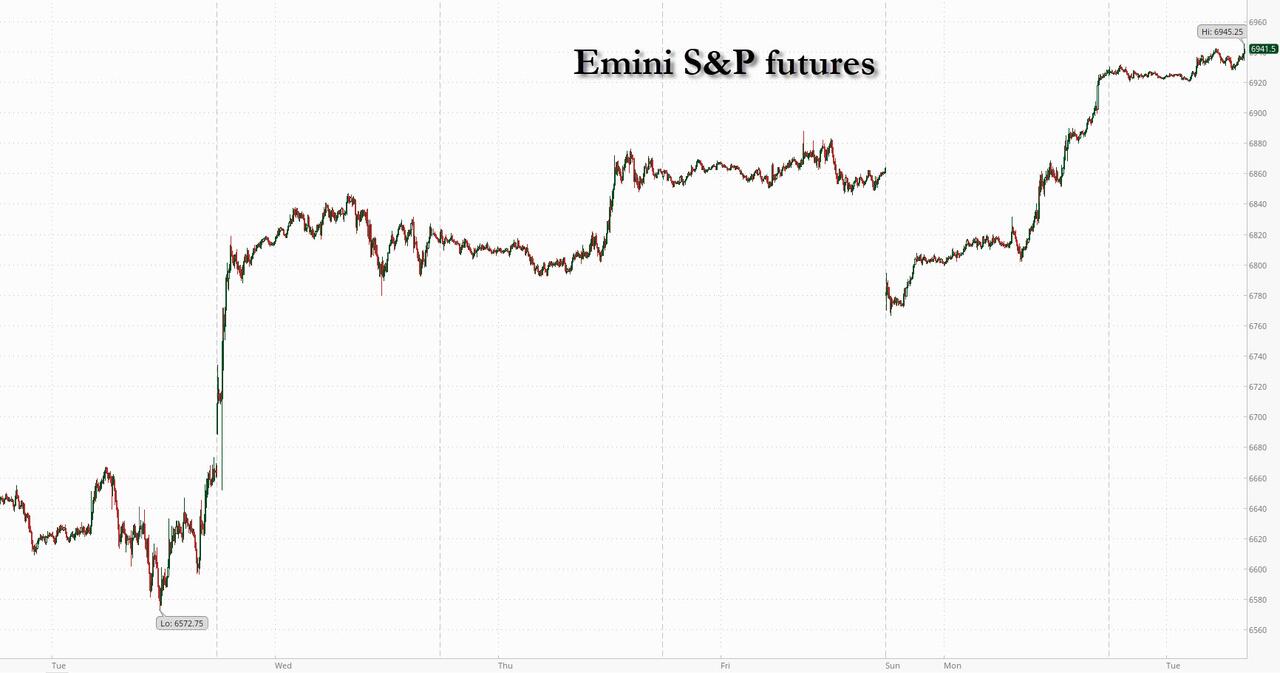
US equity futures, and global stocks rise while oil slides on a Reuters report that negotiating teams from the US and Iran could return to Pakistan later this week to resume negotiations to end the war in the Gulf, days after the first peace talks ended without a breakthrough, with chatter from Pakistani media that Trump is said to be in attendance. As of 8:00am ET, S&P 500 futures are up 0.2% while Nasdaq 100 contracts add 0.4%, as the cash index braces for a 10th straight day of gains, its longest streak of gains since 2021,with all Mag 7 stocks higher in premarket trading (Alphabet +0.9%, Amazon +0.7%, Apple +0.2%, Nvidia +0.6%, Meta Platforms +1.2%, Microsoft +1.1%, Tesla +1.9%) as tech / semis outperform other sectors; Cyclicals ex-Energy are leading Defensives. The risk-on rally is poised to continue today with the dollar weaker for a 7th day in a row while Treasuries were little changed. Gold rose 0.7% toward $4,800 an ounce. Bitcoin hit a four-week high. Brent fell 0.4% to below $99 a barrel, with the International Energy Agency estimating that the war will wipe out global oil demand growth for the first time since the 2020 pandemic, selling was boosted by Iran de-escalation hopes; Ags remain bid and precious metals continue to move inversely to the Dollar. Today’s macro data focus is on weekly ADP, Small Biz Survey, and PPI. Headline PPI (YoY expected to increase from 3.4% to 4.6%) is expected to see a significant jump with Core PPI (YoY expected to increase from 3.5% to 3.8%) increases more muted. Big banks report Q1 earnings today with consumer health the key macro read-through.
In premarket trading, Magnificent Seven stocks are all higher (Alphabet +0.9%, Amazon +0.7%, Apple +0.2%, Nvidia +0.6%, Meta Platforms +1.2%, Microsoft +1.1%, Tesla +1.9%)
- American Airlines (AAL) rises 7% as United Airlines Chief Executive Officer Scott Kirby has floated a possible combination with the carrier, according to people familiar with the conversations. Shares of United Airlines (UAL) are up 2.7%.
- Bloom Energy (BE) rises 14% after the fuel cell company expanded its partnership with Oracle to support rapid buildout of AI and cloud computing infrastructure.
- CarMax (KMX) falls 4% after the company said profit per vehicle sold to retail customers will continue to decline, and expanded its cost-cutting target.
- Credo Technology (CRDO) is up 19% after the communications equipment company agreed to acquire DustPhotonics, a Silicon Photonics PIC technology developer.
- Dell Technologies (DELL) and HP Inc. (HPQ) both slip 2% after Nvidia Corp. denied a report that it was seeking an acquisition of a large company that would “reshape the PC landscape.”
- Globalstar Inc. (GSAT) gains 8% as Amazon.com Inc. is in advanced talks to acquire the satellite operator in a deal that would boost the tech giant’s efforts to build its own satellite operation, according to people familiar with the matter.
- Lucid (LCID) rises 6% after the electric vehicle company announced a $200 million investment from Uber and a $550 million commitment from a PIF affiliate in convertible preferred shares.
- Travere Therapeutics (TVTX) soars 43% after the drugmaker said the US FDA approved Filspari (sparsentan) to help treat a rare kidney disease.
- Wells Fargo & Co. (WFC) slips 2% after the bank missed analysts’ estimates for its primary income streams in the first quarter, with net interest income totaling $12.1 billion and non-interest income coming in at $9.35 billion.
In corporate news, United Airlines CEO is said to have floated a possible combination with American Airlines, and pitched the idea to senior government officials. Amazon is said to be in advanced talks to acquire Globalstar, in a deal that would boost the tech giant’s efforts to rival Starlink.
Overnight sentiment improved on a Reuters report that the US and Iran are weighing negotiations to extend a two-week ceasefire as President Trump presses ahead with a naval blockade to curb the Islamic Republic’s oil exports. The objective is to hold fresh discussions before the truce expires, according to people familiar. The parties could return to Islamabad for talks this week, Reuters reported. There was more good news after Bloomberg reported that Iran is considering a short-term pause to shipments through the Strait of Hormuz to avoid testing a US blockade and scuppering a fresh round of peace talks, according to a person familiar with the Tehran’s deliberations.
“Markets were already leaning toward the view that diplomacy would stay alive in some form,” said Charu Chanana, chief investment strategist at Saxo Markets. “This signal matters because it turns that hope into something more tangible, and that is enough to reinforce the relief trade.”
In Iran developments, a US-sanctioned tanker linked to China is sailing out of the Strait of Hormuz in a litmus test of the US naval blockade. Chinese President Xi Jinping described the international order as “crumbling into disarray” and vowed to play a constructive role in the Middle East. Marco Rubio is hosting talks between Israel and Lebanon in Washington today.
Traders are also focused on first-quarter earnings at a time when the war in the Middle East is weighing on the outlook for the economy. JPMorgan Chase & Co. extended an underwhelming start to the earnings season for lenders, slipping 0.6% in premarket trading despite a record quarterly trading revenue haul. Wells Fargo & Co. dropped 2.7%.
“There is good value in the US equity market now. It has de-rated quite a lot and underlying profits are going to remain strong,” Peter Oppenheimer, chief global equity strategist at Goldman Sachs Group Inc., told Bloomberg TV. “If we continue to see moderation in oil prices and some of the concern about interest rate rises begin to fade, then we’ve got a reasonable degree of upside.”
In strategy, Citigroup’s Beata Manthey upgraded US equities to overweight from neutral on a “quality/defensive tilt” in their global allocation, while downgrading emerging markets stocks to neutral. Strategists at BlackRock had returned to to an overweight view on US stocks on Monday.
Meanwhile, HSBC Holdings Plc Chief Executive Officer Georges Elhedery said the war and broader “uncertainties” are beginning to dent client confidence. “We’re saddened and concerned with what’s happening in the Middle East, and we’re concerned not just with what’s happening, but also with how long this will take,” Elhedery told Bloomberg Television in Hong Kong. “Unfortunately, some of these uncertainties have initially started to weigh on general confidence.”
Bank of America’s latest Global Fund Manager Survey showed that investors are most bearish since June on expectations of higher inflation and lower economic growth. The strategists view this as a “contrarian positive for risk assets” as long as ceasefire sends oil price below $84 per barrel.
The latest in private credit includes a BlackRock fund in Asia suffering its first default by a borrower after Metcold Holdings failed to repay a loan. BlackRock 1Q results are due pre-open, see BI preview here. Meanwhile, a Blue Owl Capital private credit fund raised $400 million from bond investors, marking the first deal of its kind in over a month.
Investors will also receive the next installment of March US inflation data with Tuesday’s release of the producer price index. Similar to the consumer price report, the measure of wholesale inflation will reflect the surge in energy prices during the first month of the Iran war. Economists project the PPI rose 1.1% from a month earlier, which would be the largest increase in four years. The core PPI, which excludes energy and food, is forecast to rise 0.4% for a second month, extending a stretch of heightened wholesale inflation pressures that dates back to late 2025.
“Soaring energy prices are pushing CPI and PPI higher, but it is still too early to detect any meaningful pass-through to core inflation,” said Roberto Scholtes, head of strategy at Singular Bank. “Besides, the effect of tariffs is beginning to fade. The outlook for monetary policy is now the main driver of bond markets.
A Fed roundtable, PPI data, and an IMF-World Bank gathering will make for a busy day of headlines.
Europe’s Stoxx 600 rises 0.6%, and the Estoxx 50 is up almost 1% tracking gains in Asia overnight as optimism grows that that Washington and Tehran will eventually make their way back to the negotiating table; Automobile and technology shares led gains, while food beverage and utilities stocks lagged. Here are the biggest movers Tuesday:
- Sika shares advance as much as 9.5% after the Swiss specialty chemicals firm reported a solid first-quarter print despite a challenging backdrop from volatility in the Middle East and adverse weather in the Americas
- Givaudan shares rise as much as 6.1% to their highest in a month after the company reported sales for the first quarter that showed stronger growth in fragrances than analysts were expecting
- BE Semiconductor shares rise as much as 5.9% and hit a record after Bank of America set a Street-high target price
- Eurofins shares rise as much as 5.3% after the laboratory-testing company agreed to sell its electrical and electronic testing business for an enterprise value of €575 million target and said the Dutch chip-equipment maker could give 2Q sales guidance well above consensus expectations
- Tonies shares rise as much as 8.1%, the most since late December, after the audio storytelling system maker reported a significant improvement in profitability and outlined a positive outlook
- Imperial Brands shares fall as much as 7.9% as the maker of Gauloises and Fortuna cigarettes says it expects to lose share in its five top markets and revenues from Next-Generation Products disappoint
- LVMH shares fall 3.2% after the French luxury-goods company reported first-quarter organic revenue that missed consensus estimates, driven by the underperformance of its key fashion and leather goods division
- Abivax shares drop as much as 2.4% in Paris, adding to Monday’s 2.9% decline. Spyre Therapeutics on Monday said a mid-stage trial of its investigational therapy for moderate-to-severe ulcerative colitis met its main goal
- Kitron falls as much as 7.6%, the most since November, after DNB Carnegie cut its recommendation on the Norwegian industrial electronics firm to hold from buy
- Scatec falls as much as 7.4%, the most since January 2025, after holder Equinor sold 12.9 million shares in the company at a 7% discount vs Monday’s close. Morgan Stanley and Nordea facilitated the trade
Asian equities rose, led by artificial intelligence names, as sentiment improved amid signs the US and Iran may revive peace talks. The MSCI Asia Pacific Index gained as much as 1.9%, with Taiwan Semiconductor Manufacturing Co. and SK Hynix among the biggest boosts to the gauge. South Korea’s Kospi led advances across the region, while Taiwan’s benchmark climbed to a record high. India and Thailand were closed for a holiday. Investors are once again turning to growth sectors as Middle East tensions appear to ease. Taiwan’s stock benchmark erased all its losses since the war started at the end of February, as heavyweight TSMC jumped to an all-time high. China’s recent policy incentives for the island also helped brighten investors’ mood. Meanwhile, Singapore tightened its monetary policy settings in a widely expected move, becoming the first in Asia to respond to rising inflation risks stemming from a surge in energy prices. The Straits Times Index hovered near a record high.
In FX, the Bloomberg Dollar Spot Index is down 0.3%. The kiwi is leading gains among the G-10 currencies, rising 0.5% against the greenback.
In rates, treasuries are little changed after steady overnight price action, holding Monday’s advance. US yields remain within 1bp of Monday’s closing levels, the 10-year around 4.29%, trailing bunds and gilts in the sector by 2.5bp and 3bp respectively. European government bonds rise, as traders pare bets on tightening by the BOE and ECB this year. UK and German 10-year yields fall 4-5 bps each. IG dollar issuance slate includes a few items so far. Goldman Sachs sold a three-part offering Monday, with other issuers opting to step down. Dealers forecast around $40 billion of high-grade bond sales this week, led by US money-center banks. Focal points of US session include March PPI data and several Fed speakers.
Elsewhere, the UK sold 10-year bonds at the highest yield since the global financial crisis, drawing in record numbers of buyers keen to lock in returns that may fall back if the war comes to an end. The auction followed a surge in yields on the back of heightened inflationary risks.
In commodities, brent crude futures fall 0.6% to around $98.80 a barrel. European natural gas futures are down 3.5%. Precious metals and Bitcoin gain.
US economic data calendar includes weekly ADP employment change (8:15am New York time) and March PPI (8:30am). Fed speaker slate includes Goolsbee (9:45am, 10:15am, 12:10pm), Barr (12:45pm) and Paulson, Collins, Barkin and Barr in a 1pm panel discussion
Market Snapshot
- S&P 500 mini +0.2%
- Nasdaq 100 mini +0.4%
- Russell 2000 mini +0.5%
- Stoxx Europe 600 +0.8%
- DAX +1%, CAC 40 +0.7%
- 10-year Treasury yield -2 basis points at 4.28%
- VIX -0.5 points at 18.63
- Bloomberg Dollar Index -0.2% at 1193.72
- euro +0.2% at $1.1787
- WTI crude -2% at $97.08/barrel
Top Overnight News
- Negotiating teams from the U.S. and Iran could return to Pakistan later this week to resume negotiations to end the war in the Gulf, Pakistani and Iranian officials said on Tuesday, days after the first peace talks ended without a breakthrough. RTRS
- The US and Iran continue to exchange messages about a deal to end their war through back channels despite the failure of weekend talks to reach an agreement, said people briefed on the discussions. FT
- Tankers pass Strait of Hormuz on first day of US blockade, data shows: RTRS
- The U.S. proposed that Iran accept a 20-year moratorium on uranium enrichment during negotiations in Islamabad over the weekend, according to a U.S. official and a source with knowledge. The Iranians countered with a shorter “single digit” period, according to the sources. Axios
- United CEO Scott Kirby floated a merger with rival American Airlines that would create the world’s largest carrier, people familiar said. Shares of both companies rose premarket. BBG
- Oil demand is expected to contract 80K BPD this year (this is a sharp cut to the prior forecast) due to scarcity and high prices triggered by the Iran war. IEA
- Investors are growing increasingly worried about US life insurers’ exposure to private credit, after many firms piled into the opaque asset class in an attempt to boost their investment returns. FT
- China’s export growth declined to a six-month low in March as the Middle East conflict hit global demand outlook, while imports logged their strongest growth in more than four years. China’s exports in Mar were soft (+2.5% vs. the Street +8.6%) while imports surged 27.8% (vs. the Street +13.9%). CNBC
- BOJ officials will probably consider raising their inflation forecast sharply at their policy meeting this month to reflect elevated oil prices, people familiar said. BBG
- The UK is set to raise £15 billion from a new July 2036 gilt, in a deal that has attracted record bids of more than £148 billion. BBG
A more detailed look at global markets courtesy of Newsquawk
APAC stocks traded higher as risk sentiment was underpinned by hopes regarding US-Iran peace talks after President Trump suggested Iran called the US and wants to make a deal very badly,while a US official said that talks between the sides are continuing even now and there is progress, with some reports also noting that the second round of face-to-face talks could take place this Thursday, although there hasn’t been any confirmation. ASX 200 was lifted by outperformance in tech and miners, but with the upside capped following a deterioration in Australian Consumer Sentiment and Business Confidence surveys. Nikkei 225 rallied to just shy of the 58,000 level with tech-related stocks dominating the list of best performers, including SoftBank, Advantest, NEC Corp and Renesas, all in the top five biggest gainers. Hang Seng and Shanghai Comp gained, but with the advances limited as participants also digested mixed Chinese trade data, in which exports disappointed and imports surged, while China Customs Vice Minister said the international situation is currently turbulent, geopolitical conflicts are intensifying and global oil prices fluctuate sharply.
Top Asian News
- South Korean Pension Fund allows more FX hedging to bolster KRW, Bloomberg reported.
- China will refine its drug pricing system with 14 measures, Xinhua reported.
- China Customs Vice Minister said China foreign trade situation had a good start.
- Japanese Finance Minister Katayama said to discuss financial markets and energy conditions with counterparts at meetings and ready to roll out measures to support Asian nations. Will maintain close dialogue with JGB market participants amid rising yields. Specific monetary policy operations are for the BoJ to determine.
European bourses (STOXX 600 +0.6%) are rebounding from Monday’s losses as reports of a second round of US-Iran talks taking place as soon as Thursday brighten the risk tone.Outperformance is seen in the DAX, with gains of over 1%, while the FTSE 100 lags behind its peers. Imperial Brands (-8%) trades more softly after it delivered a trading update in which it kept its FY guidance unchanged as pricing in its tobacco business offset continued volume declines. European sectors are mainly in the green, with Utilities and Food, Beverage & Tobacco the only sectors with modest losses. Autos tops the sector pile, closely followed by Technology and Basic Resources.
Top European News
- German Wholesale Prices YoY (Mar) Y/Y 4.1% (Prev. 1.2%).
- German Wholesale Prices MoM (Mar) M/M 2.7% vs. Exp. 0.4% (Prev. 0.6%).
- Spanish Inflation Rate YoY Final (Mar) Y/Y 3.4% vs. Exp. 3.3% (Prev. 2.3%).
- Spanish Inflation Rate MoM Final (Mar) M/M 1.2% vs. Exp. 1.0% (Prev. 0.4%).
- Spanish Core Inflation Rate YoY Final (Mar) Y/Y 2.9% vs. Exp. 2.7% (Prev. 2.7%).
Geopolitics
- Next round of talks between US and Iran could take place this week or early next week, according to the Iranian embassy official in Pakistan. Further commentary by the Pakistan Foreign Ministry stating it offered to host a second round of US-Iran negotiations, no date or time has been set yet.
- Pakistani Journalist Mallick said “While Islamabad has offered to host the next round of in person talks between US and Iran, which could be held at a working level, to my understanding, date and venue for the next round has not been finalised as yet”.
- US and Iran discussing another round of face-to-face talks to secure longer-term ceasefire after Islamabad negotiations ended without a deal, while officials aim to meet again before two-week ceasefire expires next week, according to Clash report. AP also reported that US and Iran could be headed toward a second round of talks, while talks could happen on Thursday.
- US VP Vance said we made some progress in Iran talks and he wouldn’t say things went wrong, adds Iranians moved in our direction in talks but not far enough. Ball is in Iran’s court. We made it clear what US red lines are in Iran talks.
- US and Iran reportedly leave door open to dialogue after tense Islamabad talks, while a source stated that the parties came “very close” to an agreement and were “80% there”, before running into decisions that could not be settled on the spot.
- Iranian President Pezeshkian said to French President Macron in a phone call on Monday that Iran will negotiate only under international law, while he claimed that unreasonable US demands prevented an agreement in weekend talks between US and Iran. He further told Macron that a lack of US good will and maximalist positions prevented finalising an agreement in Islamabad, IRNA reports; further states that diplomacy is the preferred path to resolving disputes.
- Iranian Spokesman for the National Security Committee said the end of the truce should not lead to its extension, Al Mayadeen reported.
- US aircraft carrier USS George H.W. Bush is sailing off the coast of Africa and is heading to the Middle East to join Operation Epic Fury, according to two US officials cited by WSJ.
- Saudi Arabia is pressing the US to drop its Hormuz blockade, with Gulf energy exporters worrying that Iran could escalate and close the Bab al-Mandeb, according to WSJ.
- Alarms have sounded in the Galilee Panhandle due to concerns over potential UAV penetration.
- Lebanese source said “The official mandate of Lebanon’s ambassador in Washington is limited to pursuing a ceasefire with Israel”, via Al Jazeera.
- Switzerland is reportedly ready to help diplomatic initiatives between the US and Iran.
- Russian Foreign Minister Lavrov tells Iranian counterpart Araghchi that it is important to ensure that no new fighting breaks out, and Moscow is on high alert to help in the settlement, while the latter warned warns of dangerous consequences of US actions.
- US Secretary of State Rubio is to host Israeli and Lebanese ambassadors for talks on Tuesday, while the talks aim for ceasefire, Hezbollah disarmament and peace deal, according to Axios.
- Meeting between the Israeli ambassador and the Lebanese ambassador Lebanon will be held on Tuesday at 18:00EDT/23:00BST, according to Al Jazeera citing Israeli Channel 15 citing sources.
- Chinese President Xi makes four proposals on maintaining peace in the Middle East, according to Chinese press.
- UK Deputy PM Lammy meets with US VP Vance in Washington and urges Iran ceasefire to hold, while he stresses free shipping through the Strait of Hormuz.
Ukraine
- Russian drones attacked Ukraine’s Izmail port and damaged a Panama-flagged vessel, according to Ukraine’s Deputy PM cited by Reuters.
Others
- North Korea test fires a cruise missile and anti-warship missiles from a naval destroyer, according to KCNA.
FX
- FX began the morning with a slight positive bias which was exacerbated by reports that US and Iran will return to negotiations later in the week. This report sparked a risk-on move, with crude falling USD 1.7/bbl, DXY marking fresh session lows, and high-beta currencies benefiting. It is worth noting that the outlet that ran this headline has since tweaked the headline to “could” resume talks, when it previously said “to” resume talks. With regards to date and time, that is not yet confirmed, though Pakistani Journalist Mallick writes “While Islamabad has offered to host the next round of in person talks between US and Iran, which could be held at a working level, to my understanding, date and venue for the next round has not been finalised as yet”.
- The greenback looks to a busy day with US PPI and a packed calendar for Fed speak. Fed’s Goolsbee (2027 voter, Dovish; no text expected) will speak to Yahoo Finance, He is also set to take part in a panel discussion and give remarks to media separately today. Barkin (2027 Voter, Neutral; no text), Barr (Voter, Neutral; text expected), Paulson (2026 Voter, Dovish; no text) and Collins (2028 Voter, Neutral; no text expected) are to speak on rural economic development.
- DXY continues to trade below all significant DMAs after falling below 100- and 200-DMAs in Monday’s session. In terms of levels below, 97.87 marks the beginning of the war open, while today’s session low was marked at 98.11.
- NZD stays the best performer in the G10FX space as markets price in further bps of hikes from the RBNZ. Overnight, ANZ revised its rate outlook for the RBNZ, now forecasting hikes in July, September and October. This follows moves from other domestic banks, ASB expecting the OCR to rise in September and December to a terminal of 3.25% next year (Terminal consensus), mid next year. ANZ Chief Economist Zollner said it is fair to interpret the recent media appearances from Governor Breman as deliberate. As a reminder, Breman conveyed hawkish marks a few times last week. Elsewhere in the ANZ note, Zollner said we don’t have a strong view on July versus September. But we do have a pretty strong view that hikes will come before our previous call of December.
- JPY continues to be bound within 158-160 parameters. On Monday, remarks from BoJ Governor Ueda saw markets trim expectations of a hike in April’s meeting, with the Japanese curve implying 4bp of hikes (prev. c. 15bp). As such, the haven remains in lockstep with a slightly weaker USD (DXY -0.2%). There was a Bloomberg source that just hit the wires, which suggested BoJ was considering a sharp increase to its price forecast this month, while weighing a possible growth outlook cut due to high oil prices. This report pushed USD/JPY lower by around 10 pips to mark a session low of 158.85.
Fixed Income
- Global fixed benchmarks were firmer overnight and continued to move a little higher as the European session progressed. Initial optimism was facilitated by reports that the US is reportedly eyeing a potential second round of in-person talks with Iran as the blockade takes hold, according to CNN. AP reported that the US and Iran could be headed toward a second round of talks, which could happen on Thursday. The complex then took another leg higher after Reuters reported that US and Iranian negotiation teams are to return to Islamabad for peace talks later this week. Markets will now await any official confirmation on if/when talks begin.
- USTs are higher by 4 ticks, and currently trade within a 111-07+ to 111-14+ range. Today’s action is encapsulated by the above, but later on, the domestic docket is packed with Fed speak and US data. In brief, weekly ADP employment stats (prev. +26k average per week over the four-week window), US PPI (expected to rise 1.2% M/M vs prev. 0.7%) and NFIB Business Optimism Index are all expected. On Fed speak, Fed’s Goolsbee (2027 Voter, Dovish; no text expected), Barr (Voter, Neutral; text expected), Paulson (2026 Voter, Dovish; no text expected), Collins (2028 Voter, Neutral) and Barkin (2027 Voter, Neutral) are all to provide comments later.
- Bunds and Gilts also follow the above, extending gains of around 40 ticks and 45 ticks, respectively. For the UK, BRC Retail Sales rose 3.1% (exp. 0.9% prev. 0.7%). The firm pointed towards warmer weather/Easter holidays boosting momentum, but highlighted risks surrounding the Middle East war, which is “is weighing heavily on both retailer and consumer confidence”. On the monetary policy front, BoE’s Mann highlighted that wage expectations could rise amidst the energy price shock.
- For Germany specifically, a large jump in Wholesale Prices in March weighed on Bunds at a time, though ultimately proved fleeting. Much of the jump in prices was associated with rises in “energy products and raw materials”, amid the Iranian conflict.
- Germany sells EUR 3.953bln vs exp. EUR 5.0bln 2.50% 2031 Bobl: b/c 1.04x (prev. 1.1x), average yield 2.74% (prev. 2.72%), retention 20.9% (prev. 29.04%).
- The Netherlands sells EUR 2.81bln vs exp. EUR 2-3.0bln 2.50% 2031 DSL: avg. yield 2.795% (prev. 2.526%).
- Japan sold JPY 525bln 20-year JGBs; b/c 4.82x (prev. 3.25), average yield 3.327% (prev. 3.141%).
- Brazil to sell EUR-denominated 4yr, 7yr and 10yr debt via syndication.
- China’s Finance Ministry to reportedly meet with underwrites on Thursday to discuss ultra-long special Treasury Bond issuance, according to Reuters sources.
- France opens book to sell EUR-denominated June 2037 Green Oat via syndicate; guidance seen at +13bps to May 2036 Oat.
Commodities
- In geopolitics, President Trump said Iran had contacted the US and wanted a deal “very badly”, while a US official said talks were still continuing and progress was being made. The US and Iran are discussing a second round of talks, potentially in Islamabad on Thursday, though nuclear weapons and any Strait of Hormuz blockade remain key sticking points. More recently, an Iranian Embassy official in Pakistan said the next round of talks between US and Iran could take place this week or early next week.
- Elsewhere, the IEA completed the monthly trio of oil market reports. In its release, the IEA sees global oil supply exceeding demand by 410k BPD in 2026, (prev. 2.46mln BPD). IEA said crude, fuel, and NGL flows through Strait of Hormuz at 3.8mln BPD in early April (vs more than 20mln BPD pre-war), and added that resuming flows through the Strait of Hormuz is the single most important variable for easing pressure on energy supplies and prices.
- Brent Jun fell below USD 99/bbl (USD 96.50-99.45/bbl range), and WTI Jun resided in a USD 90.19-92.10/bbl parameter. Dutch TTF fell -2.5% in choppy trade. Natgas supply is seen as sufficient this summer despite Iran war-related disruption, with National Gas Transmission expecting domestic output and Norwegian flows to meet demand during the lower-consumption warmer months.
- Spot gold rose to levels just shy of USD 4,800/oz after a two-day decline, as signs of diplomatic engagement slightly eased inflation concerns. The yellow metal resides towards the top end of a USD 4,743-4,797/oz range at the time of writing.
- Copper hit a one-month high and other industrial metals also advanced on optimism around talks, though investors remain cautious over escalation risks. 3M LME copper resides in a USD 13,054.95- 13,201.93/t. In trade, China’s export growth slowed sharply to 2.5% Y/Y in March, missing forecasts after February’s near-40% gain, while imports surged amid energy-related disruption; analysts said Lunar New Year distortions and a high base likely exaggerated the slowdown. Elsewhere, the EU reached a prelim deal to cut tariff-free steel imports by 47% to 18.3mln metric tons per year and double out-of-quota duties to 50%, while also moving to phase out Russian steel imports, potentially by September 2028.
- Russian oil product exports from Black Sea port of Tuapse revised up to 1.27mln tons for April (vs 794k tons in prev. plan), according to traders cited by Reuters.
- IEA OMR: sees world oil demand falling by 80k in 2026 due to Iran (prev. forecast for a 640k BPD rise); sees world oil supply falling by 1.5mln BPD in 2026 (prev. forecast for 1.1mln BPD rise). SUPPLY/DEMAND IEA sees global oil supply exceeding demand by 410k BPD in 2026, (prev. 2.46mln BPD)MIDDLE EAST. IEA said crude, fuel, and NGL flows through Strait of Hormuz at 3.8mln BPD in early April (vs more than 20mln BPD pre-war). Resuming flows through the Strait of Hormuz is the single most important variable for easing pressure on energy supplies and prices. RUSSIA. Russia may struggle to produce oil above levels seen in early Q1 due to attacks on ports. Russia’s March crude production up to 8.96mln BPD from 8.67 mln BPD in February. Russia’s March crude exports up by 270k BPD from February to 4.6mln BPD.
- Ukraine’s Zaporizhzhia Nuclear power plant offsite power has been restored via one power line. This comes following reports by the IAEA saying Ukraine’s Zaporizhzhia nuclear power plant lost all off site power earlier in the morning.
- US Energy Secretary Wright said US energy prices will likely rise in the next few weeks and remain until meaningful ship traffic through the Strait of Hormuz resumes. Venezuelan oil production has surpassed 1.2mln bpd, representing a 25% increase over three months. 150mln barrels of Venezuelan oil sold since January 3rd. There is an announcement coming soon about a large American company with a history in Venezuela ramping up production. By this summer is an aggressive timeframe now for oil and gas prices to start coming down.
- Chevron (CVX) is signing a deal with Venezuela’s PDVSA aimed at increasing production by joint ventures, according to state TV, while it agrees to asset swap with PDVSA.
- China is said to ease restrictions on certain BHP (BHP AT) iron ore cargoes.
- Petrobras (PBR) reportedly in early stage talks to buy back Brazil’s Mataripe refinery from Abu Dhabi’s Mubadala.
- SHFE said it will adjust price limits and margin requirements for certain gold and silver futures contracts from listing
Trade/Tariffs
- Chinese President Xi said China and Spain should enhance cooperation and mutual trust, rejects the return to the law of the jungle, adds they are to jointly defend multilateralism and safeguard global development.
- China Foreign Ministry said if the US imposes tariffs on China over Iran related issues, China will take “firm” countermeasures.
- EU Chamber in China warns of expansion of China’s export controls and said EU companies continue to suffer from China’s export controls on rare earths, according to Handelsblatt.
- EU is considering flexibilities for methane regulation due to US pressure, while EU may ease forest protection law amid US pressure and the Trump administration is pressuring the EU to weaken Green Deal laws, according to Handelsblatt.
- EU reaches a provisional agreement on measures to limit steel imports.
Central Banks
- The BoJ is said to be considering a sharp increase to its price forecast this month, while weighing a possible growth outlook cut due to high oil prices, Bloomberg reports.
- BoE’s Mann says concerned that a price shock could show up in wage expectations; inflation expectations are very volatile if CPI is above 3-3.5%.
- ECB’s Rehn said it is unclear the war effect on medium term inflation, rate decisions not locked in beforehand. Monetary policy should not be based on a single price, such as oil; it should be based on the economy as a whole. Impact of the war on inflation is not straightforward.
- Fed’s Miran (voter, dovish dissenter) said expects inflation to be close to target in a year. No reason to think oil prices will remain elevated. Thus far, seems wise to look through this oil shock.
- The ECB is urging EU governments to fast-track common deposit insurance to break the impasse in banking integration while warning against softening guardrails to boost competitiveness, the FT reported.
- RBA Deputy Governor Hauser said not sure interest rates are at the right level to tame inflation, adds rates need to bring inflation to the 2-3% target and that Q2 headline inflation is around 5% due to fuel costs. Further, RBA’s Deputy Governor Hauser said inflation in Australia is too high and Australia’s supply capacity is constrained, adds energy price spikes has been a big income shock for Australia.
- Monetary Authority of Singapore tightens policy as expected by slightly raising the rate of appreciation of the SGD NEER policy band, while it made no change to the width and level the band is centred. In an appropriate position to respond effectively to any risk in medium-term price stability. Stands ready to curb excessive volatility in SGD NEER. MAS Core inflation will pick up and remain elevated over next few quarters. GDP growth will slow over the course of the year.
US Event Calendar
- 6:00 am: United States Mar NFIB Small Business Optimism, est. 97.9, prior 98.8
- 8:30 am: United States Mar PPI Final Demand MoM, est. 1.1%, prior 0.7%
- 8:30 am: United States Mar PPI Ex Food and Energy MoM, est. 0.4%, prior 0.5%
- 8:30 am: United States Mar PPI Final Demand YoY, est. 4.6%, prior 3.4%
- 8:30 am: United States Mar PPI Ex Food and Energy YoY, est. 4.1%, prior 3.9%
- 9:45 am: United States Fed’s Goolsbee on AP Livestream
- 10:15 am: United States Fed’s Goolsbee on Yahoo Finance
- 12:10 pm: United States Fed’s Goolsbee Speaks at Semafor World Economy 2026
- 12:45 pm: United States Fed’s Barr Speaks on Rural Economic Development
- 1:00 pm: United States Fed’s Paulson, Collins, Barkin and Barr in Fireside Chat
DB’s Jim Reid concludes the overnight wrap
The market optimism has continued this morning, with oil prices falling back amidst growing hopes that the US and Iran might still reach some kind of deal. Indeed, Brent crude is down another -1.61% overnight to $97.76/bbl, which is easing fears about a stagflationary shock, and significantly, the S&P 500 (+1.02%) closed above its pre-strike level on February 27. So as far as markets are concerned, the expectation remains that this is still likely to be a temporary conflict, with the oil futures curve heavily downward-sloping, and futures on the S&P 500 (+0.03%) pointing to modest gains once again. Moreover, that optimism has continued in Asia this morning, where the Nikkei (+2.45%), the KOSPI (+3.54%) and the CSI 300 (+0.84%) are all on track for a one-month high, alongside gains for the Shanghai Comp (+0.55%) and the Hang Seng (+0.36%).
In terms of the latest, the market mood steadily improved after Monday’s open, with the key catalyst being comments from Trump, who said “I can tell you that we’ve been called by the other side. They’d like to make a deal very badly”. So that helped push back against the more downbeat mood after the failure to reach a deal in Islamabad over the weekend. Later on, Vice President JD Vance also struck a positive tone, saying “we did make some progress in the negotiation”, and Bloomberg reported that the US and Iran are in discussions about another round of negotiations. According to the article, the goal would be to hold those talks before the two-week ceasefire expires in a week’s time. That echoed a similar a story from Axios earlier in the day, who reported that that mediators from Pakistan, Egypt and Turkey would continue talks with the US and Iran to try and reach a deal.
Collectively, this raised hopes that the two sides would ultimately reach some sort of a deal, particularly with both sides sounding open to discussions. For instance, Iran’s president said in a statement that they were prepared to continue peace talks within the framework of international law and regulations. There was also some insight from a New York Times article, who reported that the US had proposed a 20-year suspension of nuclear activity, which would allow the Iranians to claim they hadn’t permanently given up the right to produce their own nuclear fuel. By contrast, it said the Iranians had only suggested a 5-year suspension. It did say that other issues were also looming over the talks, including the restoration of free passage through the Strait of Hormuz, but that that the nuclear issue remained the central dispute, echoing Trump’s previous comments that this was the main issue.
So given the potential for further talks, investors remained hopeful that a de-escalation would be achieved, even as yesterday saw the US blockade begin on the Strait of Hormuz. According to the Wall Street Journal, there were more than 15 US warships to support the operation. And Trump himself said that if Iran’s fast attack ships came close the blockade, then “they will be immediately ELIMINATED”. Over on the Iranian side, their armed forces said in a statement that “the security of Iran’s ports in the Persian Gulf and the Sea of Oman is threatened, no port in the Persian Gulf and the Sea of Oman will be safe”. Meanwhile, there was also a Wall Street Journal report overnight that Saudi Arabia was pressing the US to drop its blockade, fearing that Iran might retaliate by disrupting other important shipping routes.
Amidst all that newsflow, the market focus was on the prospect of further talks, which helped to keep oil prices beneath $100/bbl. So Brent crude was only up +4.37% by the close yesterday at $99.36/bbl, paring back its stronger gains from earlier in the session. And this morning it’s down a further -1.61% to $97.76/bbl. We can also see that investors are still expecting a temporary conflict, as the energy futures curve is sharply downward sloping, with the 6-month Brent future at $83.55/bbl this morning, and the 12-month future at $78.57/bbl.
Away from oil, the prospect of further talks were received very positively across multiple asset classes. So that supported a broad recovery throughout the day, with the S&P 500 (+1.02%) paring back its opening losses to close above its pre-strike level on Feb 27. In fact, the index is now up +8.55% since its closing low on March 30, making this its second-best run over 9 sessions in the past 4 years, only surpassed by the bounceback after Liberation Day last year. Otherwise, both the NASDAQ (+1.23%) and the small-cap Russell 2000 (+1.52%) posted larger gains, reaching a one-month high. And cyclical stocks outperformed, with information technology (+1.72%) and financials (+1.73%) leading the gains for the S&P 500, though Goldman Sachs (-1.87%) fell back after their FICC revenue was beneath consensus expectations in Q1. Today we’ll hear from a few more US financials, including JPMorgan, Citigroup and BlackRock.
Meanwhile, US Treasuries saw a modest rally yesterday, with the 2yr yield (-2.3bps) falling to 3.78%, whilst the 10yr yield (-2.4bps) was down to 4.29%. That came as investors grew more confident that the Fed might still cut rates this year, with the probability of a cut by December up to 36% by the close. Moreover, that got a further push from some weak data on US existing home sales. They fell to an annualised rate of 3.98m in March (vs. 4.05m expected), marking its lowest level in 9 months.
Earlier in the day, the market performance had been weaker in Europe, having closed before Trump’s comments about a deal. So sovereign bond yields ended the day higher, with those on 10yr bunds (+3.5bps), OATs (+4.3bps) and BTPs (+4.4bps) all rising. And equities also fell back, with the STOXX 600 (-0.16%) down from its one-month high on Friday, though it did recover from a -1% decline intra-day.
One notable exception to the pattern of European underperformance came from Hungarian assets, which surged in the aftermath of Sunday’s election result, in which the opposition TISZA party won a two-thirds majority that will enable them to amend the Constitution. In fact, the Hungarian forint was the strongest-performing global currency yesterday, surging by +3.69% against the US Dollar. Equities surged as well, with the country’s BUX Index (+4.95%) posting its best day since 2022, despite the losses in European indices more widely. And the country’s sovereign bonds also rose sharply, with the 10yr yield (-39.1bps) posting its biggest daily decline since 2023.
Looking at the day ahead, data releases include the US PPI inflation for March. Central bank speakers include ECB President Lagarde, the ECB’s Makhlouf and Lane, the Fed’s Goolsbee, Barr, Paulson, Collins and Barkin, BoE Governor Bailey, and the BoE’s Mann and Greene. Earnings include JPMorgan, Johnson & Johnson, Citigroup and BlackRock. Finally, the IMF will release their World Economic Outlook.
Tyler Durden
Tue, 04/14/2026 – 08:23