New Mexico Is The Most-Dependent State On The Federal Govt, New Jersey The Least
How reliant is your state on Uncle Sam’s wallet?
Every year, billions in federal tax dollars are redistributed to the 50 states and the District of Columbia through grants, contracts, and benefit programs.
Visual Capitalist’s Pallavi Rao ranks the states to see who benefits the most from the flows so readers can see the fiscal winners and losers at a glance.
Data for this visualization comes from MoneyGeek, which uses Census Bureau and Bureau of Economic Analysis figures.
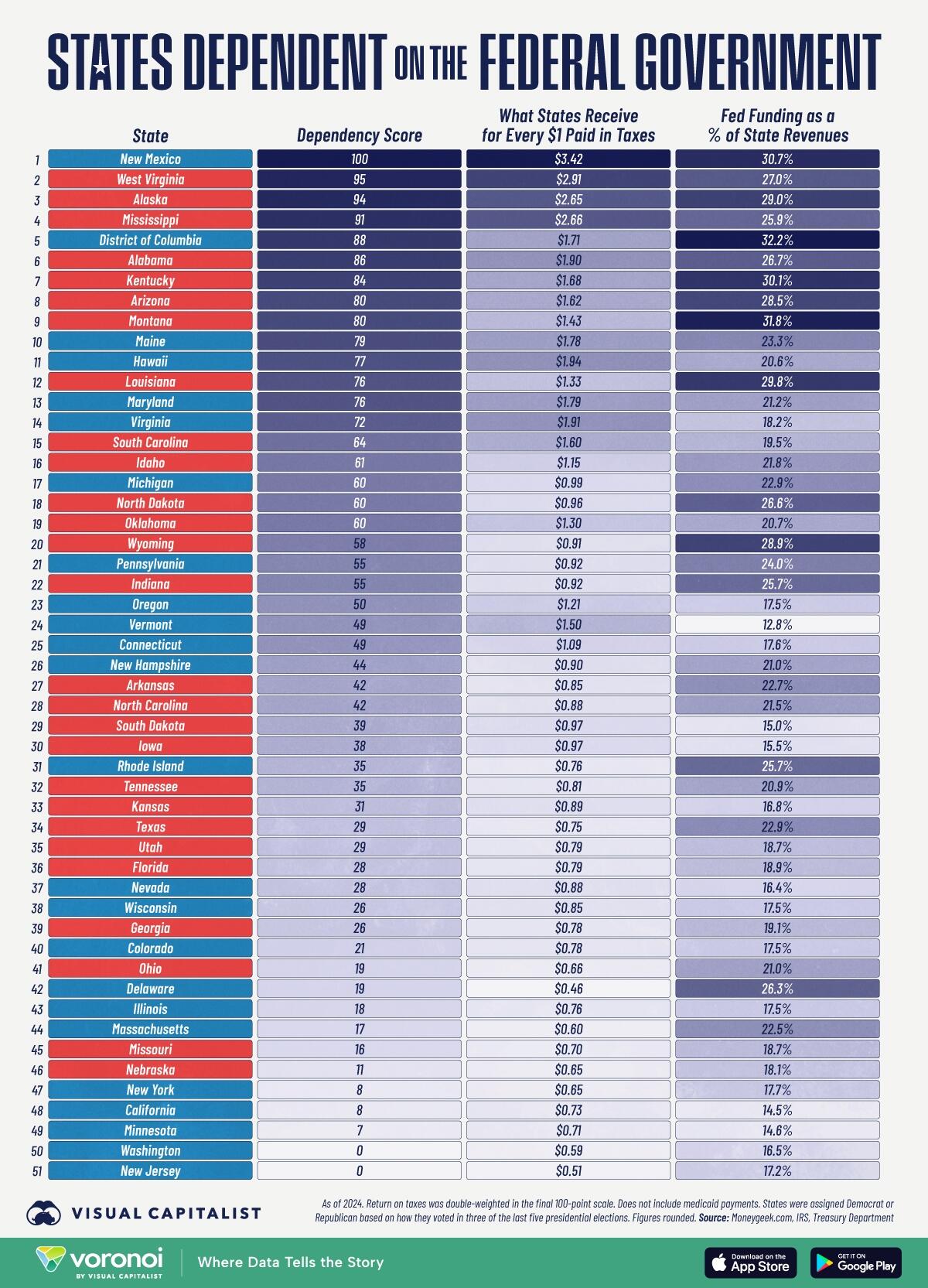
Their dependency score blends two metrics: the state’s return‐on‐taxes ratio and the share of state revenues coming from federal sources.
ℹ️ Return on taxes measures how much state residents—including businesses—receive in federal payments for every $1 paid in tax to the federal government.
Importantly, this data does not include Medicaid payments.
Finally, a state’s political affiliation is based on its voting history in the past five presidential elections.
Ranked: States That Need the Federal Government the Most
New Mexico tops the 2024 list for states most dependent on the federal government, with a perfect score of 100.
Its residents receive $3.42 for every tax dollar they send to Washington, while the state covers nearly a third of its budget with federal funds.
Rank
State
Political Affiliation
Dependency Score
Return on Taxes
% of State Revenues
From Federal Funding
1
New Mexico
Blue
100
$3.42
30.7%
2
West Virginia
Red
95
$2.91
27.0%
3
Alaska
Red
94
$2.65
29.0%
4
Mississippi
Red
91
$2.66
25.9%
5
District of Columbia
Blue
88
$1.71
32.2%
6
Alabama
Red
86
$1.90
26.7%
7
Kentucky
Red
84
$1.68
30.1%
8
Arizona
Red
80
$1.62
28.5%
9
Montana
Red
80
$1.43
31.8%
10
Maine
Blue
79
$1.78
23.3%
11
Hawaii
Blue
77
$1.94
20.6%
12
Louisiana
Red
76
$1.33
29.8%
13
Maryland
Blue
76
$1.79
21.2%
14
Virginia
Blue
72
$1.91
18.2%
15
South Carolina
Red
64
$1.60
19.5%
16
Idaho
Red
61
$1.15
21.8%
17
Michigan
Blue
60
$0.99
22.9%
18
North Dakota
Red
60
$0.96
26.6%
19
Oklahoma
Red
60
$1.30
20.7%
20
Wyoming
Red
58
$0.91
28.9%
21
Pennsylvania
Blue
55
$0.92
24.0%
22
Indiana
Red
55
$0.92
25.7%
23
Oregon
Blue
50
$1.21
17.5%
24
Vermont
Blue
49
$1.50
12.8%
25
Connecticut
Blue
49
$1.09
17.6%
26
New Hampshire
Blue
44
$0.90
21.0%
27
Arkansas
Red
42
$0.85
22.7%
28
North Carolina
Red
42
$0.88
21.5%
29
South Dakota
Red
39
$0.97
15.0%
30
Iowa
Red
38
$0.97
15.5%
31
Rhode Island
Blue
35
$0.76
25.7%
32
Tennessee
Red
35
$0.81
20.9%
33
Kansas
Red
31
$0.89
16.8%
34
Texas
Red
29
$0.75
22.9%
35
Utah
Red
29
$0.79
18.7%
36
Florida
Red
28
$0.79
18.9%
37
Nevada
Blue
28
$0.88
16.4%
38
Wisconsin
Blue
26
$0.85
17.5%
39
Georgia
Red
26
$0.78
19.1%
40
Colorado
Blue
21
$0.78
17.5%
41
Ohio
Red
19
$0.66
21.0%
42
Delaware
Blue
19
$0.46
26.3%
43
Illinois
Blue
18
$0.76
17.5%
44
Massachusetts
Blue
17
$0.60
22.5%
45
Missouri
Red
16
$0.70
18.7%
46
Nebraska
Red
11
$0.65
18.1%
47
New York
Blue
8
$0.65
17.7%
48
California
Blue
8
$0.73
14.5%
49
Minnesota
Blue
7
$0.71
14.6%
50
Washington
Blue
0
$0.59
16.5%
51
New Jersey
Blue
0
$0.51
17.2%
Note: The tax return ratio was given double-weight in the final score.
West Virginia, Alaska, and Mississippi follow closely, each exceeding $2.60 in returns and relying on federal transfers for more than a quarter of state revenues.
The outlier is the District of Columbia: despite a lower tax return multiple ($1.71), 32% of its revenue comes from the federal government. This is unsurprising given its role as the nation’s administrative hub.
Federal Dependency: Red vs. Blue States
MoneyGeek’s ranking reveals a partisan tilt: seven of the states with the top 10 dependency scores are red, including conservative strongholds such as Alabama, Kentucky, and Montana.
Meanwhile, 11 of the 20 net tax recipient states have voted Republican in at least three of the past five presidential elections.
Yet political color is not destiny. Deep-blue New Mexico and D.C. also sit near the top.
MoneyGeek’s analysis points to economic structure rather than ideology: energy extraction, military installations, and a high share of retirees often correlate with greater federal inflows.
The Big List of Donor States
At the opposite end, New Jersey and Washington score zero, receiving roughly half a dollar back for every dollar paid their residents pay in taxes.
California, New York, and Minnesota also run sizable “deficits,” each collecting less than 75 cents on the dollar.
These donor states tend to have large, diversified economies and higher-than-average household incomes, boosting tax receipts while limiting eligibility for certain federal aid programs.
Their contributions effectively subsidize public services elsewhere—fueling perennial debates over tax fairness and redistribution.
For more insights, cross-reference this post with Visualizing $29 Trillion Economy by State on Voronoi, the new app from Visual Capitalist.
Tyler Durden
Tue, 07/01/2025 – 20:30