Minnesota Is The Most Financially Literate State In The US
How well are Americans managing their money, and how does it vary between the states?
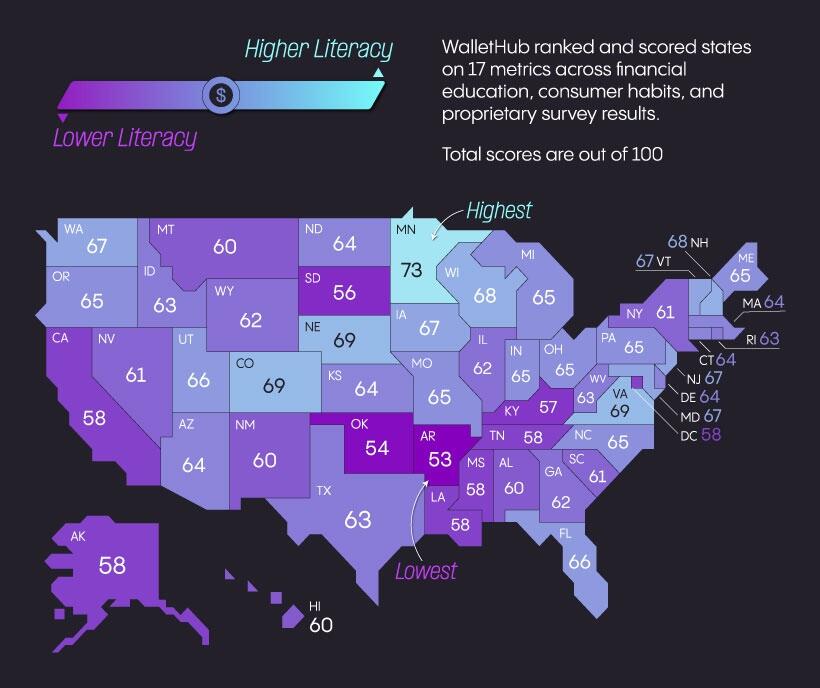
This financial literacy map, via Visual Capitalist’s Pallavi Rao,attempts to answer both questions using 2025 data from WalletHub, a personal finance services company.
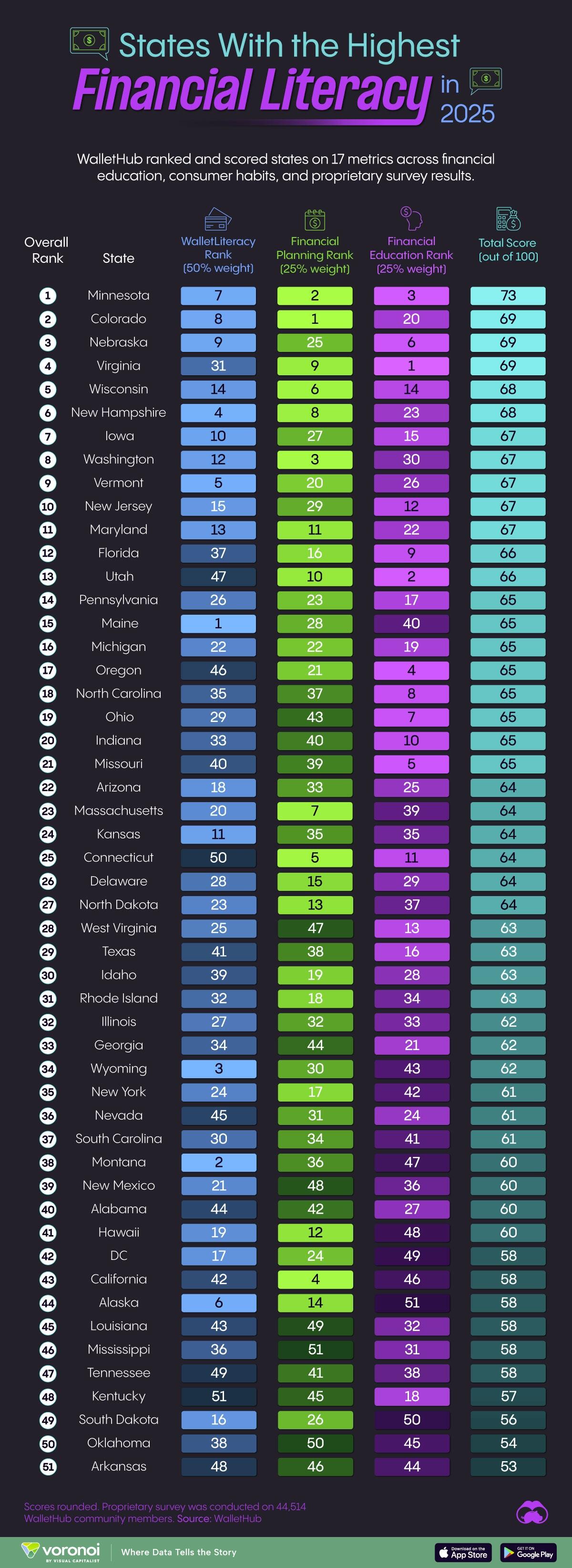
They ranked and scored states on three main benchmarks: financial education, financial planning (or consumer habits), and how Wallethub’s own users performed on their financial literacy survey.
ℹ️ These benchmarks are further subdivided into 17 metrics (credit score, savings, personal finance courses, etc.) and are weighted differently. Please read the source’s methodology section for a full breakdown.
The Most Financially Savvy U.S. State
Minnesota is the most financially literate U.S. state with 73 points, according to WalletHub’s latest analysis.
Here’s some sub indicators where Minnesota outperformed the rest of the country.
High-schoolers must take at least one personal finance program.
Only 15% of the surveyed Minnesotans spent more than they made—the lowest across all states.
Highest median credit score in the country (751).
And here’s how each state scores out of 100. Figures are rounded.
Rank
State
State Code
Total Score
(Out of 100)
1
Minnesota
MN
73
2
Colorado
CO
69
3
Nebraska
NE
69
4
Virginia
VA
69
5
Wisconsin
WI
68
6
New Hampshire
NH
68
7
Iowa
IA
67
8
Washington
WA
67
9
Vermont
VT
67
10
New Jersey
NJ
67
11
Maryland
MD
67
12
Florida
FL
66
13
Utah
UT
66
14
Pennsylvania
PA
65
15
Maine
ME
65
16
Michigan
MI
65
17
Oregon
OR
65
18
North Carolina
NC
65
19
Ohio
OH
65
20
Indiana
IN
65
21
Missouri
MO
65
22
Arizona
AZ
64
23
Massachusetts
MA
64
24
Kansas
KS
64
25
Connecticut
CT
64
26
Delaware
DE
64
27
North Dakota
ND
64
28
West Virginia
WV
63
29
Texas
TX
63
30
Idaho
ID
63
31
Rhode Island
RI
63
32
Illinois
IL
62
33
Georgia
GA
62
34
Wyoming
WY
62
35
New York
NY
61
36
Nevada
NV
61
37
South Carolina
SC
61
38
Montana
MT
60
39
New Mexico
NM
60
40
Alabama
AL
60
41
Hawaii
HI
60
42
District of Columbia
DC
58
43
California
CA
58
44
Alaska
AK
58
45
Louisiana
LA
58
46
Mississippi
MS
58
47
Tennessee
TN
58
48
Kentucky
KY
57
49
South Dakota
SD
56
50
Oklahoma
OK
54
51
Arkansas
AR
53
Meanwhile, Arkansas tested the worst, with 53 points. Its score is impacted by having the second-worst performance on WalletHub’s financial literacy survey.
And here’s each state’s rank within the three main benchmarks.
Rank
State
WalletLiteracy Rank
(50% Weight)
Financial Planning
Rank (25% Weight)
Financial Knowledge
Rank (25% Weight)
1
Minnesota
7
2
3
2
Colorado
8
1
20
3
Nebraska
9
25
6
4
Virginia
31
9
1
5
Wisconsin
14
6
14
6
New Hampshire
4
8
23
7
Iowa
10
27
15
8
Washington
12
3
30
9
Vermont
5
20
26
10
New Jersey
15
29
12
11
Maryland
13
11
22
12
Florida
37
16
9
13
Utah
47
10
2
14
Pennsylvania
26
23
17
15
Maine
1
28
40
16
Michigan
22
22
19
17
Oregon
46
21
4
18
North Carolina
35
37
8
19
Ohio
29
43
7
20
Indiana
33
40
10
21
Missouri
40
39
5
22
Arizona
18
33
25
23
Massachusetts
20
7
39
24
Kansas
11
35
35
25
Connecticut
50
5
11
26
Delaware
28
15
29
27
North Dakota
23
13
37
28
West Virginia
25
47
13
29
Texas
41
38
16
30
Idaho
39
19
28
31
Rhode Island
32
18
34
32
Illinois
27
32
33
33
Georgia
34
44
21
34
Wyoming
3
30
43
35
New York
24
17
42
36
Nevada
45
31
24
37
South Carolina
30
34
41
38
Montana
2
36
47
39
New Mexico
21
48
36
40
Alabama
44
42
27
41
Hawaii
19
12
48
42
District of Columbia
17
24
49
43
California
42
4
46
44
Alaska
6
14
51
45
Louisiana
43
49
32
46
Mississippi
36
51
31
47
Tennessee
49
41
38
48
Kentucky
51
45
18
49
South Dakota
16
26
50
50
Oklahoma
38
50
45
51
Arkansas
48
46
44
There’s some further insights to explain some noticeable geographic trends.
Colorado and Nebraska also require personal finance education in high school.
Kentucky, Oklahoma, and Arkansas have the lowest share of adults with emergency cash.
A higher share of Southern state residents borrow from non-bank lenders, affecting their financial planning score.
The Overlooked Part of Financial Literacy: Managing Debt
While investing in the markets is all the rage—particularly with the rise of no-fee platforms—WalletHub’s benchmarks prioritize an often overlooked part of money management: debt.
America’s credit card debt collectively crossed $1 trillion in 2023, and it’s only been growing since.
On average, American households have about $5,000 in outstanding credit card balances, which can take anywhere between one to two years to pay off depending on monthly incomes.
Of course, managing expenditures to avoid or reduce debt has been particularly difficult in the multiple years of post-pandemic inflation.
Need more money management insights about the United States? Check out: America’s Average Bank Account Balance, by State for a quick overview.
Tyler Durden
Mon, 05/12/2025 – 05:45